


Deprecated: mb_convert_encoding(): Handling HTML entities via mbstring is deprecated; use htmlspecialchars, htmlentities, or mb_encode_numericentity/mb_decode_numericentity instead in /var/www/nairametrics/wp-content/themes/nairametrics/functions.php on line 104
Nigeria’s greatest asset, we are told, is its people: young, numerous, the fuel of a trillion-dollar economy.
There is only one problem with this comforting story. No one has actually counted them in twenty years.
Nigeria has not conducted a national census since 2006.
Every figure since then is a projection, and they do not agree.
Also Read
Officially the country is now put at 233 to 242 million, but independent analyses dispute that in both directions: some, using satellite and survey methods, argue the true figure is tens of millions lower; others note that those same methods undercount the rural and slum populations where many Nigerians live.
The honest position is that we do not have a reliable, census quality count, and the credible estimates differ by tens of millions. Many of the numbers we use to describe Nigeria’s economy, income per person, poverty rates and estimates of market size, rest on that denominator.
A young population is only an asset, though, if it works. So how many Nigerians actually have jobs? In 2023 the official unemployment rate fell from 33 percent to about 4 percent. The economy had not experienced anything remotely resembling the broad improvement in productive employment that such a fall would imply.
What changed was the definition: Nigeria adopted the international labour standard, under which anyone who worked one hour in a week, for any pay, counts as employed. That standard is not wrong, and it is used the world over.
But it means the headline now measures whether a person is doing any paid activity at all, not whether they have decent, productive work that pays enough to live on. By the narrow measure almost everyone is employed. By measures of decent and productive employment, the picture is very different.
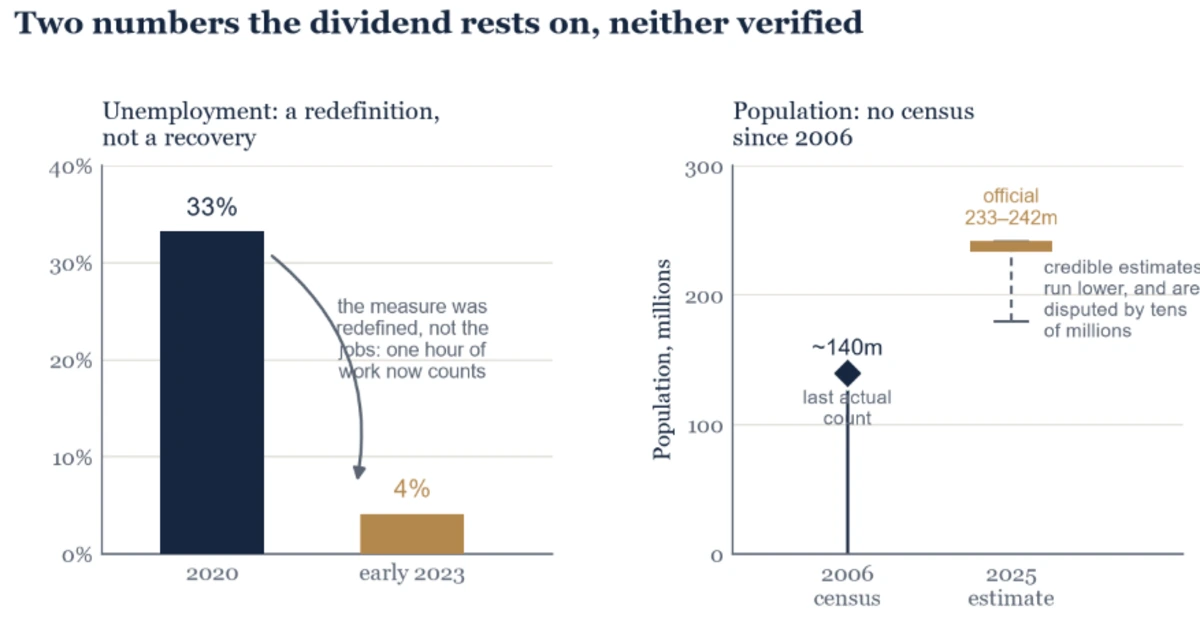
Put the two together and the celebrated demographic dividend looks like a slogan resting on air, a claim about young people, productively employed, when we cannot reliably count the first and the second is far smaller than the headline suggests. And it helps to be precise about what a dividend even is, because it is not a matter of simply having many young people.
It works through a chain: as families have fewer children, the working age share of the population rises relative to those who depend on it, and that larger workforce, if it is healthy, educated and employed, produces and saves more, and growth accelerates.
Every link is a condition, not a promise. The Asian tigers paid the bill first, in schools, clinics and jobs, and collected the dividend. Those that did not were left with a vast young population and nothing for it to do.
Nigeria has barely begun that chain. Its women still have about 4.8 children each, so the dependency burden remains heavy. The median citizen is eighteen. Millions reach working age every year into an economy not making enough decent jobs to hold them.
For anyone deploying capital here, none of this is abstract. Every business case in Nigeria, the size of the market, income per head, the number of customers you can win, rests on that uncounted population and that redefined workforce.
The honest response is to model a range rather than defend one number, to trust what you can actually observe, real transactions and distribution volumes, more than headline figures built on a population no one has counted, and to underwrite incomes and decent jobs, not headcount. A young population is a market only when it earns.
But the deepest problem is not demographic. It is that we keep making trillion-dollar plans on numbers we have never counted, or have quietly redefined.
The most useful thing Nigeria could do for its young is also the most boring: conduct a real national census, and measure honestly how many people have decent work. An asset you have not counted and cannot yet employ is not yet an asset. It is a promise. And promises, unlike dividends, have to be kept.
This is part of a series exploring whether, and how, Nigeria can become a one trillion-dollar economy, and the numbers behind the claim.
Frank Nnamka is a private equity and impact investor. He writes here in a personal capacity, and the views expressed are his own and do not reflect the position of his employer or any organisation he is affiliated with.



Warning: Undefined variable $post_id in /var/www/nairametrics/wp-content/themes/nairametrics/comments.php on line 134
Warning: Undefined variable $post_id in /var/www/nairametrics/wp-content/themes/nairametrics/comments.php on line 134