
Nigeria invests about as much as the Asian tigers once did. It simply does not grow like them.
That single fact holds one of the most important truths about the country’s trillion-dollar ambition.
According to the National Bureau of Statistics, Nigeria puts about a third of its entire economy into investment, roughly 32 to 35 percent in recent years.
That is almost exactly what India, Indonesia and Vietnam invest. Yet those countries grew at 6 to 7 percent a year for a generation, while Nigeria, on a similar share, has grown at about 4 percent, and less than that for each person as the population rises. Same effort. Very different result.
Also Read
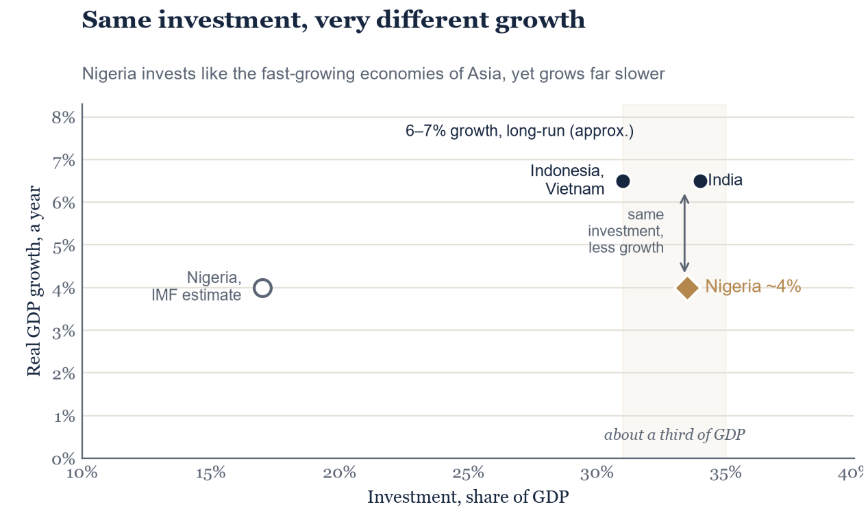
So Nigeria’s problem is not how much it invests. It is what it gets back. The return that matters is growth: how much extra output each naira of investment produces. On that measure Nigeria is far behind.
The figure is debated, and the International Monetary Fund puts Nigeria’s investment lower, near 17 percent. But the puzzle holds either way. Whether the share is a third or a sixth, the growth it yields is modest.
Where does the return go? Much of it is spent standing in place. A Nigerian business builds its own power because the grid is unreliable. It moves goods through crowded ports and difficult roads at a cost its rivals abroad never carry.
It bears insecurity in some regions, and policy that can change without much warning. Investment that replaces a broken grid keeps the lights on. It does not make the country richer.
This changes what the trillion-dollar task really is. Nigeria does not, on its own numbers, need to summon the will to invest more. It already invests a great deal.
What it needs is to make each naira go further, by fixing the shared foundations that swallow the returns. Reliable power, smoother logistics, greater security and steadier policy would lift the return on every naira already invested, all at once. It is the cheapest growth the country can buy.
For anyone putting money to work here, this reframes what to look for. The scarce thing in Nigeria is not capital. It is return. The businesses that win are the ones that remove a constraint draining everyone else’s returns, in power, logistics, payments or storage, or that are shielded from those constraints by design.
Returns rise fastest wherever the foundations improve, so the developments worth watching are not the headline growth targets but the quieter fixes to power, ports and policy. In Nigeria, you underwrite the environment as much as the business.
So, can Nigeria generate the growth a trillion dollars needs? It has the effort, and by its own figures much of the capital. What it lacks are the conditions that turn capital into growth. The country is not standing still. It is running hard with the brakes on. The money is being spent. The task is to make it count.
This is part of a series exploring whether, and how, Nigeria can become a one trillion-dollar economy. Next in the series: is Nigeria preparing its people to power the growth?
Frank Nnamka is a private equity and impact investor. He writes here in a personal capacity, and the views expressed are his own and do not reflect the position of his employer or any organisation he is affiliated with.