

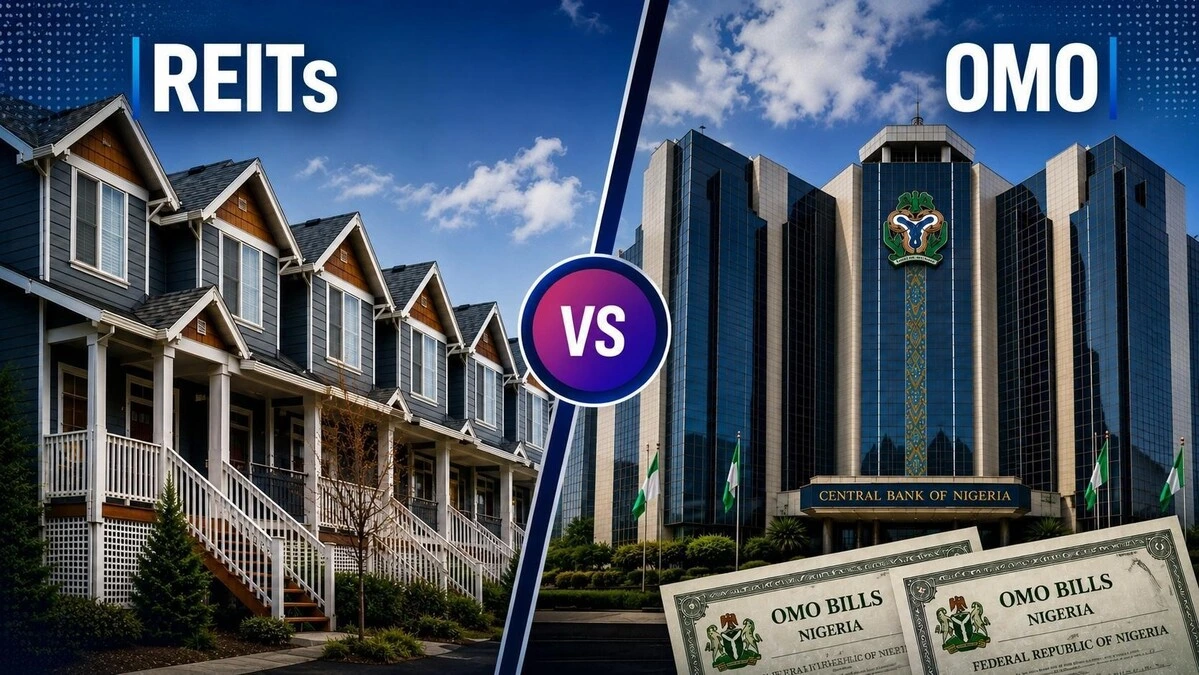
The return of high fixed-income yields has created a new calculation for investors.
With the Central Bank of Nigeria reopening Open Market Operations (OMO) securities to individuals, companies and non-bank financial institutions through deposit money banks, investors now have greater access to an asset offering relatively high and more predictable returns.
At last auction, investors submitted N4.93 trillion for just N600 billion of OMO bills, with the securities clearing around the 20% mark.
Treasury Bills are offering similarly attractive returns. At the August auction, the 364-day stop rate rose to 17.59%, despite N4.19 trillion in subscriptions for N500 billion on offer.
Also Read
That creates an obvious question for anyone holding stocks: if you can now earn close to 20% from fixed income, why take the additional risk of owning equities?
The question is particularly relevant after the recent correction in Nigerian stocks. The NGX All-Share Index fell for 10 consecutive sessions after reaching a record high on August 10, giving back part of its earlier gains.
But high-yielding fixed income does not necessarily make equities irrelevant but raises the hurdle that equities must clear.
Investors now have to be more selective about what they own and what they expect those investments to deliver.
- A stock with little dividend income, weak earnings growth or limited prospects for capital appreciation becomes harder to justify when an investor can earn roughly 18% to 20% from fixed-income securities.
But that does not apply equally to every part of the equity market. Some listed stocks offer income alongside the potential for capital appreciation.
That creates a different proposition for investors who still want equity exposure but are increasingly conscious of the income they could earn elsewhere.
REITs and infrastructure funds are among the clearest examples
They allow investors to participate in income-generating assets while retaining the possibility of making money when the market value of their units rises.
The question, then, is not simply whether REITs can beat a 20% OMO yield. It is whether their distributions, combined with potential capital appreciation, can make the equity risk worthwhile.
The case for looking at them becomes clearer when their income potential is placed alongside the broader NGX market.
- On a dividend-yield basis, some REITs and infrastructure funds are among the highest-yielding listed securities on the exchange.
- MREIF ranks at the top of the schedule with an 18.33% yield, while CNIF is at 11.73%.
- Among the three core REITs, UH REIT has a 7.93% yield, SFS REIT 6.76%, and UPDC REIT 5.25%.
Only a few conventional listed companies, including GTCO at 9.99% and Zenith Bank at 8.20%, rank alongside these funds on a yield basis
So, while many stocks may struggle to compete with an OMO yield approaching 20%, some income-oriented listed funds offer relatively high distributions and, importantly, the potential for capital appreciation can materially improve their total return.
The recent performance of some of these securities illustrates the point. MREIF is currently trading at N100, unchanged year-to-date, while CNIF has gained 54.3%. UH REIT has risen 35%, and UPDC REIT has gained 101.45% this year. SFS REIT, meanwhile, has remained flat at N418.75.
This means the investment proposition is not simply about whether a fund can match OMO’s yield. For some listed funds, the income return can be supplemented by a rise in the unit price, creating a total-return proposition that fixed-income securities do not provide in the same way.
In other words, the 20% OMO yield may raise the hurdle for equities, but it does not raise it equally for every security. That is where selectivity comes in.
What are REITs and infrastructure funds?
A Real Estate Investment Trust (REIT) is a pooled investment vehicle that allows investors to own an interest in income-generating real estate without having to buy, manage or finance a property.
Instead of putting millions of naira into an office building, shopping centre, residential development or other property, an investor buys units in a REIT.
The fund pools investors’ money and invests it in real estate assets, with the income generated from those assets distributed to investors according to the fund’s structure and distribution policy.
Because some REITs are listed on the NGX, their units can also be bought and sold on the exchange. This means an investor’s return can come from periodic distributions and changes in the market price of the units.
Nigeria’s listed REIT market currently includes UPDC REIT, UH REIT and SFS REIT, which are the three core REITs listed on the NGX. They do not all invest in the same properties, nor do they have identical earnings, distribution or share-price performance.
The market has also expanded beyond the traditional REIT structure.
MOFI Real Estate Investment Fund (MREIF) is a closed-end real estate investment fund established by the Ministry of Finance Incorporated and listed on the NGX in November 2025. Unlike a conventional open-ended fund, a closed-end fund generally has a fixed number of units in issue, with investors buying and selling those units in the secondary market.
Another listed fund is Nigeria Real Estate Investment Trust (NREIT), managed by Chapel Hill Denham Management Limited. NREIT focuses on income-generating Nigerian real estate and was listed on the NGX Main Board in December 2025.
- As a REIT, its underlying investments are primarily real estate assets, with investors participating through listed units and distributions from the fund.
For infrastructure funds, we have Coronation Infrastructure Fund (CNIF). It invests in infrastructure-related assets rather than primarily in real estate.
- It was listed on the NGX in August 2025 and provides investors with exposure to infrastructure and can make periodic distributions from income generated by its investments.
Where the numbers land
The recent performance of listed REITs and related funds shows why investors need to look beyond headline yields.
Investors can buy these units through the NGX, just like other listed securities, and earn distributions while retaining the possibility of capital gains.
- MREIF Series II distributed N8.61 per unit in H1 2026. At its N100 market price, that represents an 8.6% six-month yield, or about 17.2% annualised if the pace is repeated. Its price has remained flat year-to-date.
- CNIF distributed N8.985 per unit for H1 2026. At N154.30, this is a 5.8% six-month yield, or roughly 11.6% annualised. However, its unit price has gained 54.3% year-to-date.
- Among the core REITs, UH REIT’s N5.55 distribution yields about 7.9% at N70, alongside a 35% YTD price gain.
- SFS REIT’s N28.30 annual distribution yields 6.8% at N418.75, while its price is flat.
- UPDC REIT’s N0.40 H1 distribution yields 2.9% at N13.65, but its price has surged 101.5% YTD.
The numbers show that income and capital appreciation can come in very different combinations, which is precisely why selectivity matters.



Warning: Undefined variable $post_id in /var/www/nairametrics/wp-content/themes/nairametrics/comments.php on line 134
Warning: Undefined variable $post_id in /var/www/nairametrics/wp-content/themes/nairametrics/comments.php on line 134