

The economics of home security in Nigeria are changing. For the better part of two decades, effective surveillance infrastructure meant a significant capital outlay: professional installation, dedicated DVR hardware, a tangle of cables run through walls, and an ongoing dependence on technicians for maintenance and repair.
The result was a clear segmentation. Businesses, high-income households, and institutional properties could afford proper surveillance. Everyone else made do with what they could, or went without.
That segmentation is now under structural pressure, driven by a convergence of falling hardware costs, the democratisation of AI-powered computer vision, and a new generation of wireless battery-powered cameras that require neither complex infrastructure nor professional installation.
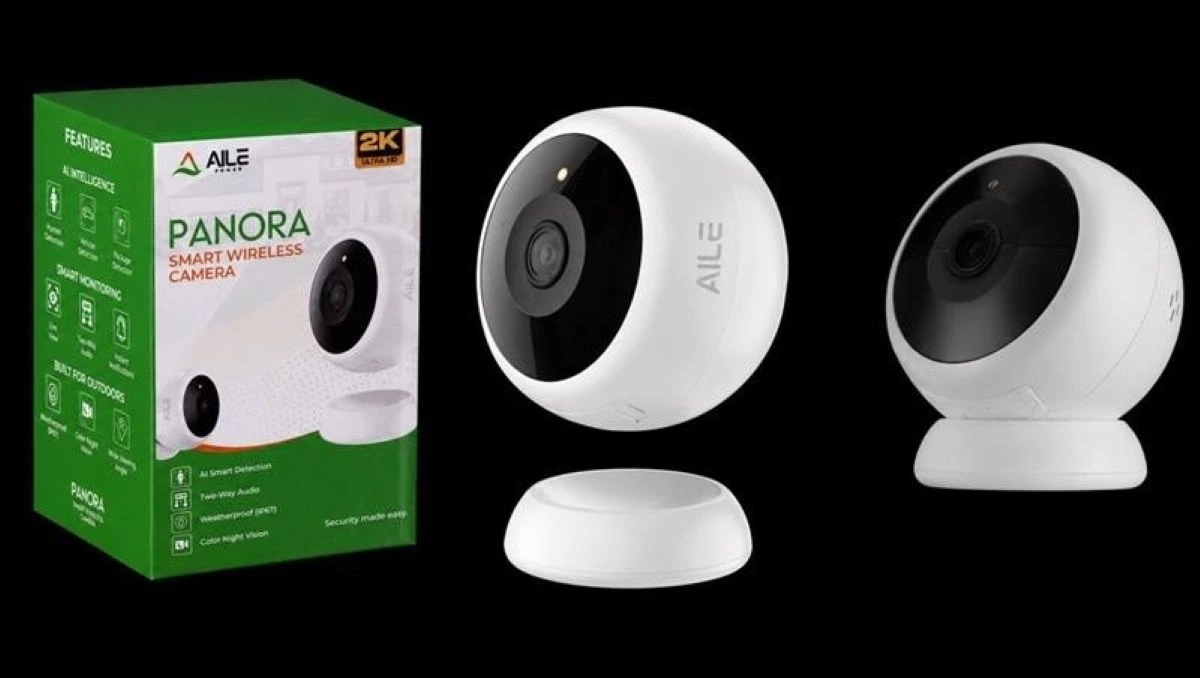
Into this environment, Aile Power has introduced the Panora Smart Wireless Camera to the Nigerian market, a product whose specifications and pricing model reflect a deliberate bet on the next phase of security technology adoption across the country.
Also Read
Understanding the Market Opportunity
Nigeria’s home and business security market has long operated below its potential penetration. The barriers were never primarily about demand. The desire to protect property, family, and business assets is universal and, in the Nigerian context, acutely felt. The barriers were structural: cost, installation complexity, infrastructure dependency, and the general unavailability of products designed for the specific environmental conditions of Nigerian life.
Smart home security camera adoption is now expanding globally at a significant pace, driven by AI integration and the sharp reduction in the price of high-quality image sensors. The African market, and Nigeria specifically, represents one of the highest-growth frontiers for this category, precisely because existing penetration is low and the unmet demand is substantial.
The Panora camera enters this market with a specification set that addresses the structural barriers directly.
Battery-powered wireless operation eliminates infrastructure dependency. A magnetic mount and five-minute setup process eliminates installation complexity. IP67 weatherproofing, the international standard for dust-tight and water-resistant enclosures, makes the device suitable for the outdoor Nigerian deployment contexts, gates, compounds, driveways, commercial frontages, where security needs are highest.
The AI Layer and Its Commercial Significance
What separates the Panora camera from its predecessors in the affordable security segment is not merely the wireless form factor. It is the integration of an AI detection engine capable of classifying movement by object type: human beings, vehicles, and packages.
The commercial significance of this distinction is often underestimated. A security camera that generates false alerts, triggered by weather events, shadows, or animal movement, creates what security researchers call alert fatigue. Users who receive enough false positives begin to disengage from their notification systems, which defeats the purpose of real-time surveillance entirely.
A camera that filters intelligently, alerting users only to classified events that match predefined security-relevant categories, produces a fundamentally different user relationship. The device earns consistent engagement rather than training its users to ignore it. In market terms, this translates into higher retention, stronger word-of-mouth adoption, and a product category that compounds its penetration rather than stalling at early adopters.
The Panora camera’s AI package includes human detection, vehicle detection, and package detection, all processed on the device itself rather than sent to a cloud server for analysis. This edge processing model reduces data consumption and maintains alert performance across variable internet connectivity, a meaningful practical advantage in the Nigerian network environment.
Colour Night Vision and the Evidence Quality Argument
Security cameras are not merely deterrents. They are evidence collection systems, and the quality of the evidence they collect has direct implications for insurance claims, police reports, and property dispute resolution.
The Panora camera’s colour night vision capability preserves full-colour footage across low-light and zero-light conditions, as opposed to the infrared monochrome standard of most comparably priced alternatives. Given that a disproportionate share of property security incidents occur at night, the practical value of maintaining colour fidelity in night footage, the clothing colour of an individual, the make and registration of a vehicle, represents a meaningful upgrade in the evidentiary quality of what a camera captures.
Distribution and Market Positioning
The Panora camera is managed through the VicoHome Smart Home Camera application, available on Google Play and the Apple App Store, and is designed for self-installation. This go-to-market architecture is consistent with the broader global shift toward direct-to-consumer smart security products that eliminate the installer as a required distribution intermediary.
For the Nigerian retail market, this model has implications for the speed and cost of market penetration. A product that moves through consumer electronics retail channels and e-commerce platforms rather than through specialist security installers reaches a substantially larger addressable market and at a lower customer acquisition cost.
Aile Power’s Panora camera is entering a Nigerian market that is primed for this category. The combination of strong unmet demand, a product specification built for local conditions, and a distribution model designed for broad consumer reach positions the product at an inflection point in Nigeria’s smart security adoption curve.
Nigeria’s smart security market is not simply following global trends. It is developing its own adoption logic, shaped by specific environmental conditions, infrastructure realities, and a consumer base that is increasingly sophisticated in its technology expectations. Products that acknowledge those local conditions in their design, rather than simply being imported and marketed, are the ones most likely to build durable market share.
The Panora camera from Aile Power reflects that acknowledgement. Whether it becomes a significant player in this market will depend on execution, distribution, and the degree to which its AI-powered promise holds up in daily Nigerian use. The conditions for success are present. The question is what comes next.



Warning: Undefined variable $post_id in /var/www/nairametrics/wp-content/themes/nairametrics/comments.php on line 134
Warning: Undefined variable $post_id in /var/www/nairametrics/wp-content/themes/nairametrics/comments.php on line 134