

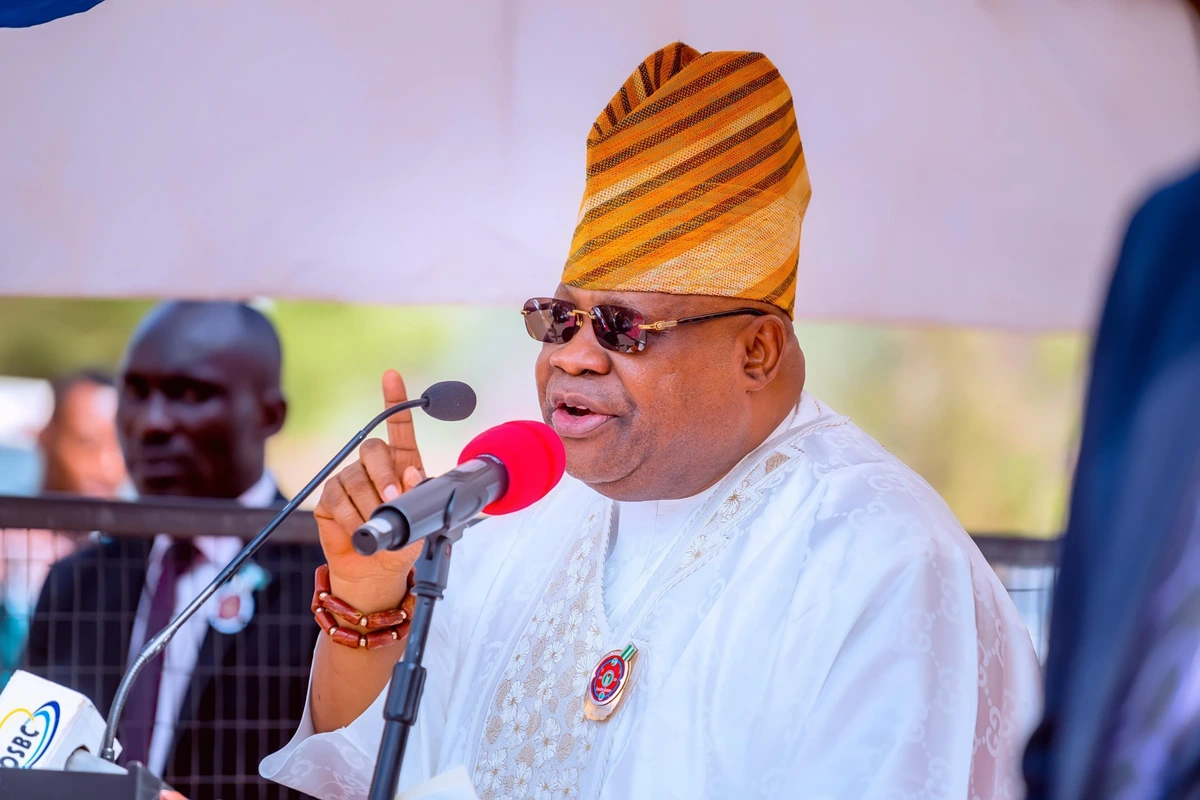
Osun State Governor Ademola Adeleke has filed a N2 billion lawsuit against the Economic and Financial Crimes Commission (EFCC), challenging what he described as the unlawful freezing of the state’s Federal Statutory Allocation Account.
The suit, filed before the Federal High Court in Abuja, also lists the Attorney General of Osun State and the Accountant General of the state as the second and third plaintiffs, respectively.
The defendants are the EFCC, its Chairman, and First Bank Nigeria Limited.
The legal action comes just hours after President Bola Tinubu directed the EFCC to vacate the freezing order placed on the Osun State Government’s account, saying he was embarrassed by the timing of the development because it could create the impression of federal interference in the state’s governorship election.
Also Read
What they are saying
In the suit, the Osun State Government is asking the court to declare the EFCC’s action unlawful and unconstitutional, arguing that the commission had no legal authority to freeze the state’s allocation account without following due process.
The plaintiffs are challenging whether the EFCC can lawfully freeze, restrict or place a post-no-debit order on a state government account without first obtaining and serving a valid order from a court of competent jurisdiction.
- They argued that the commission’s directive amounted to “an egregious act of executive lawlessness”, “a flagrant abuse of statutory powers”, and a violation of the constitutional principles of due process, the rule of law, and the financial autonomy of Osun State.
The government is seeking a declaration that the freezing of its account was unlawful, unconstitutional and of no legal effect. It also wants the court to nullify the restriction placed on the account, order First Bank to immediately remove all restrictions and restore unrestricted access to the account, and restrain both the EFCC and the bank from imposing similar restrictions in the future except in accordance with the law.
In addition, the plaintiffs are asking the court to award ₦2 billion as exemplary and aggravated damages for what they described as the unlawful interference with public funds, as well as the cost of the litigation.
No date has been fixed for the hearing of the case.
Get up to speed
The lawsuit follows an EFCC investigation into the Osun State Government over the alleged fraudulent handling of Ecology Funds, Intervention Funds and Federal Account Allocation Committee (FAAC) funds amounting to about N11 billion.
- The commission said it had been investigating the state since March 2026, and that several officials, including the state’s Accountant General, had been questioned by investigators.
- The commission argued that its preventive mandate requires it to safeguard public funds and that allowing the transfers to continue would have been irresponsible.
The controversy escalated after President Tinubu publicly distanced himself from the timing of the account freeze.
- In a personally signed statement, the President said he felt “deeply embarrassed, not by the EFCC’s exercise of its mandate backed by a court order, but by the timing of the agency’s action.”
Tinubu subsequently directed the EFCC to immediately approach the court to vacate the freezing order and discontinue the action against the Osun State Government.
What you should know
The EFCC’s decision to freeze the Osun State Government’s account has triggered a wider debate about the powers of anti-corruption agencies and the constitutional financial autonomy of states.
- The Nigerian Bar Association (NBA) criticised the blanket freezing of the state government’s accounts, arguing that such a measure could effectively paralyse government operations.
- NBA President Afam Osigwe (SAN) said that while the EFCC may seek court orders to freeze specific accounts linked to alleged criminal activity, a blanket restriction on a state government’s accounts raises serious constitutional and legal concerns.
The Osun lawsuit is therefore expected to test the limits of the EFCC’s investigative powers, the scope of judicial oversight in financial crime investigations, and the constitutional protections available to state governments under Nigeria’s federal system.



Warning: Undefined variable $post_id in /var/www/nairametrics/wp-content/themes/nairametrics/comments.php on line 134
Warning: Undefined variable $post_id in /var/www/nairametrics/wp-content/themes/nairametrics/comments.php on line 134