

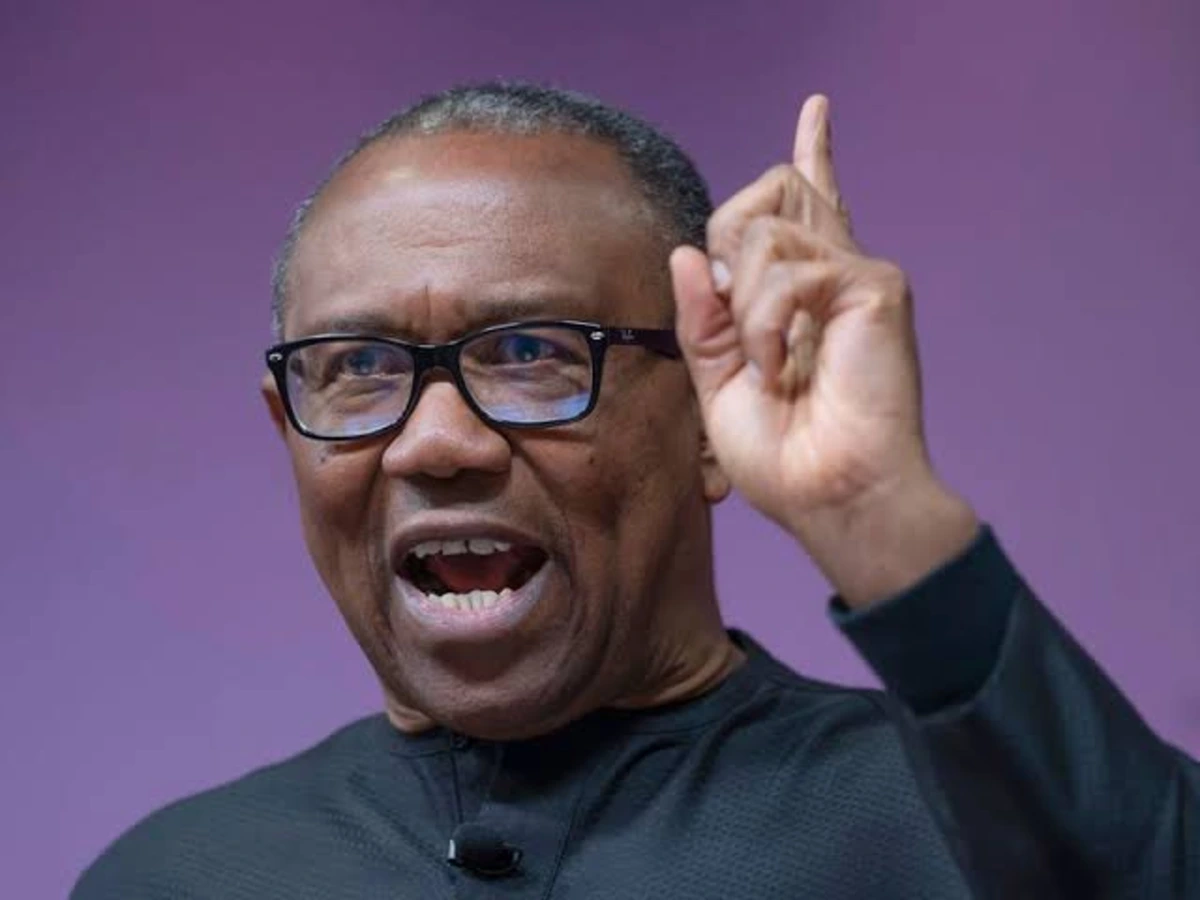
Peter Obi, the presidential candidate of the Nigeria Democratic Congress (NDC), has pledged to reduce interest rates if elected, saying Nigeria’s current borrowing costs are crippling small businesses.
Obi made the remarks on Sunday, July 26, during an appearance on Politics Today on Channels Television, hosted by Seun Okinbaloye, where he outlined how he would revive the economy through cheaper credit for businesses and increased investment in agriculture and manufacturing.
His criticism comes six days after the Central Bank of Nigeria (CBN) retained the Monetary Policy Rate (MPR), the country’s benchmark interest rate, at 26.5%, as the Monetary Policy Committee (MPC) maintained its tight monetary policy stance aimed at curbing inflation and sustaining macroeconomic stability.
What Peter Obi is saying
Obi argued that government should focus on creating an enabling environment for entrepreneurs rather than directly engaging in production, stressing that small businesses remain the largest employers of labour in successful economies.
Also Read
Drawing comparisons with countries such as Indonesia, he said governments that prioritise small businesses provide affordable financing, training and other forms of support that enable enterprises to thrive.
- “The government supports them with training and loans at less than 10%—actually about 5%. How can you do small business in Nigeria with no support, no training, and interest rates at 35%? It is impossible.”
According to Obi, supporting manufacturers and visiting factories to understand their challenges is central to building a productive economy rather than one driven by consumption.
- “I know the biggest problem for manufacturers today in Nigeria is interest rate,” he said.
When asked directly whether he would reduce interest rates if elected president, Obi replied:
- “Of course, yes,” he answered, adding that his background in building businesses and in the corporate world qualifies him to know exactly what to do to drive the interest rate down.
Get up to speed
The CBN last week retained the Monetary Policy Rate at 26.5%, following the conclusion of the 306th Monetary Policy Committee meeting held in Abuja on July 20 and 21, 2026.
According to the apex bank, the decision is intended to sustain the moderation in inflation, preserve stability in the foreign exchange market and consolidate recent macroeconomic gains.
The bank noted that headline inflation eased marginally to 15.91% in June 2026, from 15.93% in May, although food inflation accelerated on a monthly basis to 3.75% from 2.98%.
On agriculture
Obi said Nigeria possesses enough fertile land to achieve food security and become a leading agricultural exporter, arguing that agriculture could eventually generate more revenue than crude oil if properly developed.
- “This country can produce enough of what we can eat. We can actually make more money from agriculture than we make from oil, because as of today, we have vast uncultivated land.”
He said Nigeria currently produces less than 10 million tonnes of paddy rice annually, a figure he described as inadequate for a country of its size, while blaming cheap imports for discouraging local farmers.
Using Bangladesh as an example, Obi noted that the South Asian country, despite having significantly less land than Nigeria, now produces between 50 million and 60 million tonnes of paddy rice annually.
He also compared Nigeria’s agricultural potential with that of the Netherlands, which earns over €120 billion annually from agricultural exports despite occupying only about 33,000 square kilometres of land.
Obi argued that insecurity has prevented states such as Niger from fully utilising their vast arable land, while areas such as Sambisa, Taraba and the Mambilla Plateau could be transformed into centres for commercial agriculture.
According to Obi, expanding agricultural production would also help tackle unemployment and insecurity by providing young people with sustainable livelihoods.
- “The only way you can pull Nigeria out of poverty and increase GDP is through production, not consumption. Production in agriculture gives you food, gives raw materials for factories, and gives export value. It is a win-win.”
What you should know
Peter Obi served as Governor of Anambra State between 2006 and 2014 and emerged as one of the major contenders in Nigeria’s 2023 presidential election under the Labour Party, attracting widespread support, particularly among young voters.
He has since declared his intention to contest the 2027 presidential election and in May announced former Kano State Governor Senator Rabiu Musa Kwankwaso as his running mate.
The development sets the stage for what is shaping up to be another three-way contest, with President Bola Tinubu expected to fly the flag of the All Progressives Congress (APC), while former Vice President Atiku Abubakar is the presidential candidate of the African Democratic Congress (ADC).
Warning: Undefined variable $post_id in /var/www/nairametrics/wp-content/themes/nairametrics/comments.php on line 134
Warning: Undefined variable $post_id in /var/www/nairametrics/wp-content/themes/nairametrics/comments.php on line 134