
 Follow Us on Google Discover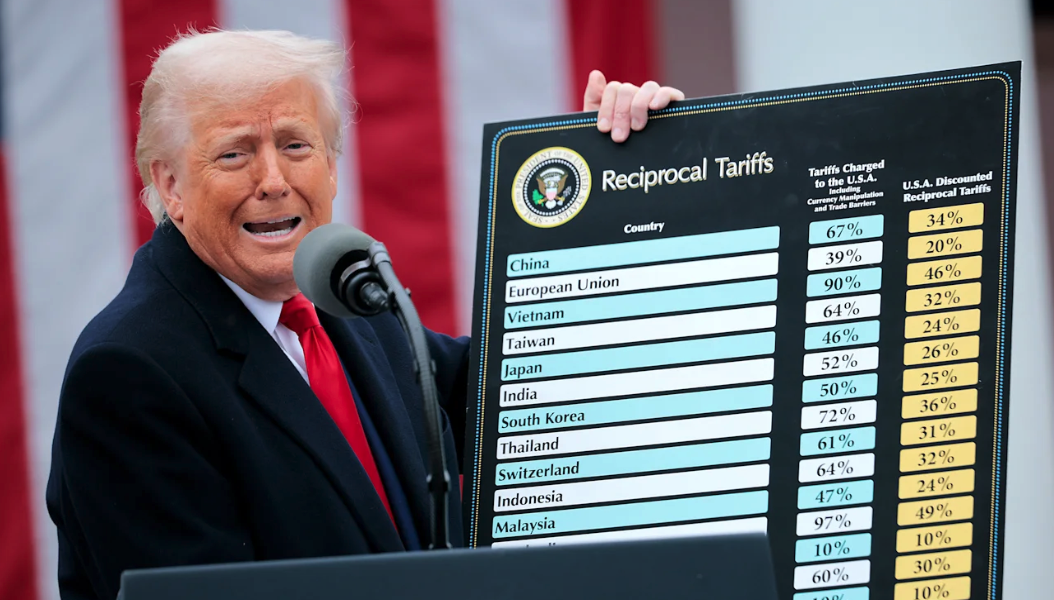
When a country aims to correct a bilateral trade deficit with another trading partner through tariffs, while simultaneously running a large public deficit, the policy mix produces unexpected consequences.
From a simplistic view, tariffs reduce imports, lessen bilateral imbalances, and protect domestic industries.
Similarly, expansionary fiscal policy (shown by high public spending) boosts domestic demand and stimulates short-term growth.
However, when used simultaneously, these policies reshape the structure of the current account without actually resolving the aggregate imbalance.
Other News
They also affect exchange rates in ways that undermine competitiveness and reallocate employment, rather than increase it, mostly to the detriment of long-run productivity.
This article explores the consequences of such a policy mix by delving into international economics theory, macroeconomic transmission mechanisms, empirical assessments, and Reis’s analysis of the Portuguese slump and crash.
Overall, this highlights the flaws of using tariffs to correct imbalances in the long term, while also showing how public deficits and exchange rates interact to disrupt employment.
A bilateral trade deficit appears when a country imports more from a certain trading partner than it exports, leading to a net leakage from its circular flow of income.
For instance, in 2017, the US ran a bilateral trade deficit of $375 billion with China, illustrating a sort of economic dependency on China by the US from both a political and economic standpoint.
However, economists suggest that such deficits simply reflect patterns of comparative advantage and global value chains rather than being problematic, and that a country’s aggregate current account balance is what measures its true external position.
Despite this, governments still frequently implement bilateral tariffs to correct bilateral deficits. Tariffs increase the price of imports, making them less competitive compared to domestic substitutes and suppliers from other countries, visibly narrowing the bilateral deficit.
This dynamic is illustrated by the US-China trade war, where the United States imposed hundreds of billions of dollars in tariffs on Chinese goods, causing the bilateral deficit to narrow. However, the US maintained an overall high trade deficit as imports shifted to Vietnamese, Mexican, and Taiwanese manufacturers rather than domestic ones.
Similarly, in the 1981 US-Japan tensions, after the US introduced voluntary export restraints (VERs) and tariffs on Japanese automobile manufacturers, Japanese imports reduced, but this incentivised firms to move production abroad. This led to little overall change in the aggregate deficit.
This pattern was also evident when Argentina imposed tariffs between 2008 and 2015, suggesting that tariffs can correct bilateral trade deficits but rarely reduce the aggregate deficit.
The saving-investment identity elaborates on why tariffs fail to address overall external balances. Current Account (CA) = National Saving – Investment. This equation, derived from the national income identity, suggests that tariffs are not a factor in determining a country’s current account position.
National saving is comprised of private and government saving (the budget balance). A large fiscal deficit is reflected by negative government saving, which reduces national saving and therefore causes the current account to remain in deficit, unless offset by higher private saving or lower investment.
This illustrates that a current account deficit is more a result of large public spending than bilateral trade deficits, a relationship known as the “twin deficits hypothesis.”
This underlying identity shows that tariffs do not alter the fundamental saving-investment balance unless the tariff revenues are explicitly used to reduce the fiscal deficit.
However, as only around 5% of government revenues come from tariffs, this can be ruled out as inefficient. At most, tariffs reallocate the composition of imports and exports, producing bilateral adjustments without actually altering the macroeconomic drivers of a country’s external position.
This is echoed in the IMF’s 2023 External Sector Report, which deems fiscal policy, rather than tariffs, one of the most powerful levers to adjust external balances, as trade policy has limited aggregate effects.
If the aim of a country is solely to reduce trade with a particular partner, tariffs are highly effective in reorienting the composition of the current account, as they reduce trade from targeted partners. However, they just divert imports to non-targeted suppliers, creating trade diversion. Export performance may also suffer due to the Lerner Symmetry.
Abba Lerner’s theory explains that an ad valorem tariff has the same effect as an export tax because it alters relative prices, making exports less competitive.
This is because tariffs affect domestic prices for producers (by increasing the price of intermediary goods and reducing availability) in proportion to the level of the tariff, making them less internationally competitive.
This effectively acts as a tax on them, even without considering the likelihood of retaliation by trading partners, reducing the amount they are able to export and worsening the current account.
Meanwhile, persistent fiscal deficits require external borrowing, which gradually worsens the income balance of the current account as interest payments and dividend outflows to foreign lenders grow.
Thus, tariffs and deficits combined reshape the current account toward fewer imports from targeted partners, worse export performance overall, and greater net income outflows.
The exchange rate plays a crucial role in offsetting the effects of tariffs. A large fiscal deficit, especially when financed by foreign capital inflows, leads to upward pressure on domestic interest rates to prevent inflation from spiralling out of control.
These higher interest rates attract ‘hot money’ (capital inflows) from external firms and banks, leading to appreciation of the exchange rate. This appreciation offsets the initial effects of tariffs, as it makes imports cheaper and, as a result, reduces export competitiveness.
In addition, tariffs themselves can also produce appreciation of the exchange rate, reducing their effectiveness. By initially reducing imports, tariffs temporarily improve the trade balance, increasing demand for domestic currency and attracting an influx of ‘hot money.’
In a floating exchange-rate system (the most common type), this appreciation counteracts much of the trade-balance gain. As Krugman and Obstfeld emphasise in their works, relative-price adjustments and exchange-rate movements often neutralise unilateral trade-policy changes, reducing their effectiveness.
Similarly, Mankiw’s account of policy transmission reinforces this point. As fiscal expansion raises domestic demand and interest rates, it causes currency appreciation, reducing net exports.
Therefore, the combination of tariffs and high public (fiscal) spending creates a cycle of fiscal expansion ,strengthening the currency, while tariffs internalise demand. This leaves the aggregate current account largely unchanged.
There are more complex and sector-dependent effects on employment. In the short run, tariffs can protect import-competing industries, boosting employment in these sectors.
For instance, US steel producers largely benefited from tariffs on Chinese steel. Simultaneously, exporters and firms reliant on imported intermediary goods faced higher costs and reduced demand, leading to higher average costs and job losses or slower employment growth.
However, the fiscal deficit stimulates overall domestic demand, which creates jobs in non-tradable sectors, such as construction. This is reinforced by exchange-rate appreciation, which makes non-tradables more attractive relative to tradables.
Over time, this causes a shift away from more productive tradable sectors, which drive growth, to lower-productivity non-tradables.
This was evident in Portugal’s experience in the 2000s, as described by Ricardo Reis, where the dangers of this trajectory were clear. In the years prior to the euro crisis, Portugal had a high domestic demand for non-tradables, resulting in a large current account deficit.
This led to a rise in employment in construction, while services stagnated. However, when the crisis hit, Portugal faced high unemployment and a collapse in growth. This demonstrates how fiscal-driven demand can distort employment and reduce long-term economic prospects.
In conclusion, the combination of tariffs aimed at correcting bilateral trade deficits and large public spending may be politically attractive but economically flawed. Tariffs may narrow bilateral deficits; however, they do not address the aggregate current account position, which is mainly driven by the saving-investment balance.
Instead, using these two policies reshapes the composition of the external accounts, produces exchange-rate appreciation, and reallocates employment away from more productive sectors.
Over time, this leads to vulnerabilities in the form of larger income outflows, retaliation from trading partners, and structural misallocation of labour and resources.
This teaches the overarching lesson that tariffs shift the where of deficits, but fiscal and structural reforms are the policies needed to address the why.
This article was written by Tochukwu Z. Oji, an A-level Nigerian student in the UK. He is studying politics and economics, with a specific interest in the influence of political decisions on global economic markets. He can be reached at [email protected].
 Follow Us on Google Discover


Nigeria is poor because we import practically everything: we import used foreign vehicles, we import expired rice, we import used clothing, we import toothpicks, we even import our passports. When we import, we lose jobs and foreign currency.
Warning: Undefined variable $post_id in /var/www/nairametrics/wp-content/themes/nairametrics/comments.php on line 134
Warning: Undefined variable $post_id in /var/www/nairametrics/wp-content/themes/nairametrics/comments.php on line 134