
 Follow Us on Google Discover
Deprecated: mb_convert_encoding(): Handling HTML entities via mbstring is deprecated; use htmlspecialchars, htmlentities, or mb_encode_numericentity/mb_decode_numericentity instead in /var/www/nairametrics/wp-content/themes/nairametrics/functions.php on line 104
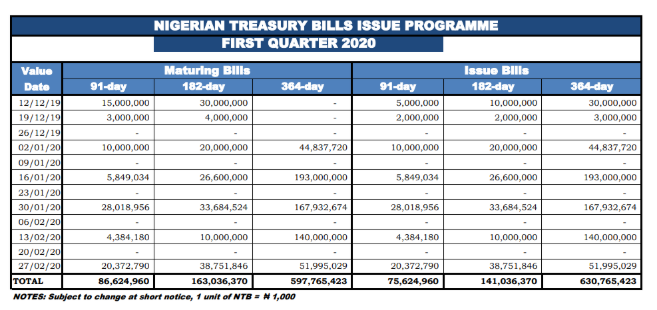
The Central Bank of Nigeria (CBN) has published its Treasury Bills programme for January–March 2020, indicating that it planned to raise about ₦847.4 billion in cash.
The disclosure was made by the CBN in the Treasury Bill programme document released on its website, covering the first quarter of 2020. The N847.4 treasury bill issued for Q1 2019 represents a drop by N155.2 billion when compared to the over 1 trillion issued in Q4 2019.
The details: The breakdown of the document shows that N86.6 billion will be raised in the 91-day maturity period, N163 billion for 182 days and N597.7 billion for 364 days maturity period.

Other News
Basically, the CBN sells T-bills on a bi-weekly basis to investors and is one of the safest investments available. Interests are paid upfront and the principal paid in full upon maturity.
The CBN’s policy: T-billa are mostly sourced from financial institutions. Once again, the bank issues treasury bills regularly as a control measure to help banks mop up excess liquidity and control the money supply.
(READ MORE: CBN and other industry stakeholders establish N1 billion Bankers’ Charitable Endowment Fund)
Following an earlier report that the CBN had ordered commercial banks and other financial institutions not to sell treasury bills to individuals and small firms from November 29, 2019, the apex bank has said its directive only affects the Open Market Operations. The development means that the treasury bill is still open to individuals and small firms.
Understanding Treasury Bills: Basically, when the government is going to the financial market to raise money, it can do it by issuing two types of debt instruments – treasury bills and government bonds. Treasury bills are issued when the government needs money for a short period while bonds are issued when it needs debt for more than say five years. The issuance of treasury bills is also used as a mechanism to control the circulation of funds in the economy.
Treasury bills have a face value of a certain amount, which is what they are actually worth. However, they are sold for less. For example, a bill may worth N10,000, but you would buy it for N9,600. Every bill has a specified maturity date which is when you receive the money back.
The government then pays you the full price of the bill (in this case N10,000), giving you the opportunity to earn N400 from your investment. The amount that you earn is considered as the interest, or your payment for lending your money to the government. The difference between the value of the bill and the amount you pay for it is called the discount rate and is set as a percentage.
 Follow Us on Google Discover


Good evening Bamidele, thanks so much for this salient write up about the the raise of #878. 4 billion through treasury bills by the federal govt for the first quarter of January next year 2020. Please could you please tell me what the interest rate ll be for a 364 days tenure? Thank you.
Pls note: you can reply me via the email I sent below
Interest rate as at today for 365days is 5%
Are you sure individuals can still participate in Nigerian treasury bills
Warning: Undefined variable $post_id in /var/www/nairametrics/wp-content/themes/nairametrics/comments.php on line 134
Warning: Undefined variable $post_id in /var/www/nairametrics/wp-content/themes/nairametrics/comments.php on line 134