
 Follow Us on Google Discover
Deprecated: mb_convert_encoding(): Handling HTML entities via mbstring is deprecated; use htmlspecialchars, htmlentities, or mb_encode_numericentity/mb_decode_numericentity instead in /var/www/nairametrics/wp-content/themes/nairametrics/functions.php on line 104
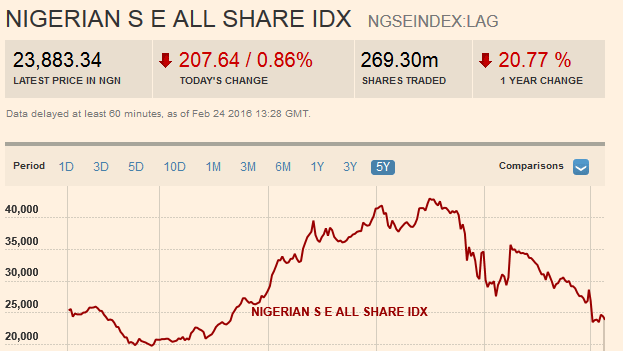
Stocks: Nigerian Stocks resumed their selloff today with the benchmark NSEASI down 0.86 percent to 23,883.34 points.
The index is down 17.47 percent in the past year and 16.62 percent year to date.
Five year charts show the 20,000 point as the next major support levels for the index.
Other News
Naira: The naira continued to strengthen on the black/Parallel markets on Wednesday as speculators unloaded dollars. The naira firmed to N302/$ checks from black market dealers showed.
Bonds: FGN Bond yields fell across most tenure and bonds rallied. The benchmark 10 year 16.39 due Jan 2022 had fall by 0.19 percent to 11.76 percent, FMDQ data show.
FAAC: Nigeria’s government revenues fell in January to N370.388 billion ($1.86 billion), down from N387.777 billion in December, due to a drop in oil prices, Finance Minister Kemi Adeosun said in a statement.
The revenue includes VAT, refunds from state oil firm NNPC and exchange gains, the statement said. It will be distributed to the federal, state and local authorities.
Adeosun also said that the rainy day fund, the Excess Crude Account, remained unchanged at $2.26 billion.
SA vs. Nigeria borrowing
The net borrowing requirement — the amount needed to fund the South African budget deficit — will fall to 156.3 billion rand ($10.3 billion) in the next fiscal year, from 172.8 billion rand.
Domestic-bond sales are forecast to drop to 174 billion rand ($11.1 billion) in the next fiscal year from 175 billion this year.
By comparison Nigeria is set to borrow N1.8 trillion ($9 billion) to fund its deficit this year.
Domestic Nigerian bond sales are forecast at N940 billion ($4.7 billion) about 42 percent of South African issuances for the fiscal year.
 Follow Us on Google Discover


Warning: Undefined variable $post_id in /var/www/nairametrics/wp-content/themes/nairametrics/comments.php on line 134
Warning: Undefined variable $post_id in /var/www/nairametrics/wp-content/themes/nairametrics/comments.php on line 134