
 Follow Us on Google Discover
Deprecated: mb_convert_encoding(): Handling HTML entities via mbstring is deprecated; use htmlspecialchars, htmlentities, or mb_encode_numericentity/mb_decode_numericentity instead in /var/www/nairametrics/wp-content/themes/nairametrics/functions.php on line 104
After America dominated the 20th century, a view formed that Asia would be the next to lead the world in economic and cultural influence. Africa may have something to say about that before the century is out.
The continent will claim three of the world’s 10 most populous countries in 2050, according to projections released Tuesday by the Population Reference Bureau in Washington. The largest of those, Nigeria, will be just 1 million people shy of the U.S.’s size, with Democratic Republic of the Congo and Ethiopia entering the list. They replace Russia and Mexico, with the former’s exit leaving Europe with no country on the top 10 list.
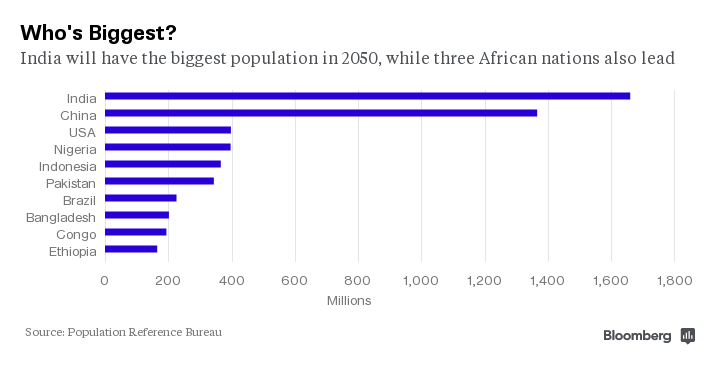
Key to the countries’ growth? Babies. While the U.S. and other developed countries struggle to adapt their labor forces to an aging population, African countries are experiencing a baby boom. Niger, South Sudan, Democratic Republic of the Congo, Somalia and Chad have the highest fertility rates in the world.
Other News
That may be one reason a majority of Africans surveyed by Pew Research Center believe today’s children will be better off financially than their parents when they grow up.
Looking farther east, China is currently the world’s most populous nation, though it’s seen being lapped by India by 2050, according to PRB, a nonprofit group that analyzes and disseminates demographic data and research.
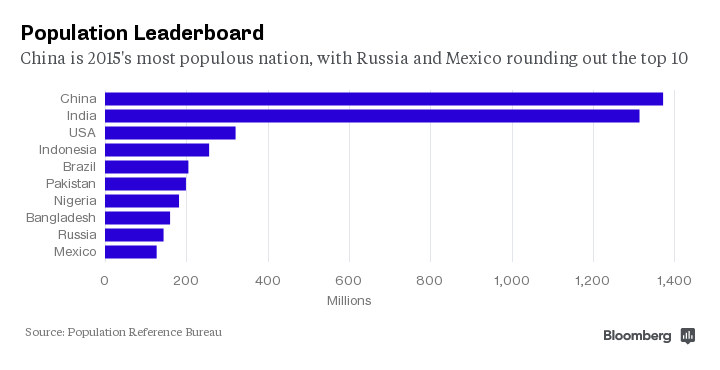
“China for several decades has been focused on driving down fertility rates,” Goldstein said. “India’s population is growing at a relatively moderate pace, but China’s projected fertility rates will be below replacement level.”
Source: Bloomberg
 Follow Us on Google Discover


Who said so ?Nigeria have double it’s population since it’s first census in independence from the british colonist.it’s more possible for Nigeria to have a population of 300 millions Nigeria in 20 yrs,the first post independence said Nigeria population is 60 millions Nigeria,by the next 2 census,the population hit 120 millions Nigerians,and it start to decline by it’s projection estimates,the causes of this decline is (1) economic uncertainity (2)lack of social and economic mobilities (3)lack of essential facilities,e.g good housing,free or affordable medical systematic deliverance.(4)lack of basic educational system,where nigerians are free mentally and spiritually,to discipline the body and the spirit to pursues his happiness.for more than 500 yrs,we Africans are importing foreign religion,foreign educational system to contaminates our mind and our souls.or corrupts our mind.e.t.c, e.t.c
Warning: Undefined variable $post_id in /var/www/nairametrics/wp-content/themes/nairametrics/comments.php on line 134
Warning: Undefined variable $post_id in /var/www/nairametrics/wp-content/themes/nairametrics/comments.php on line 134